

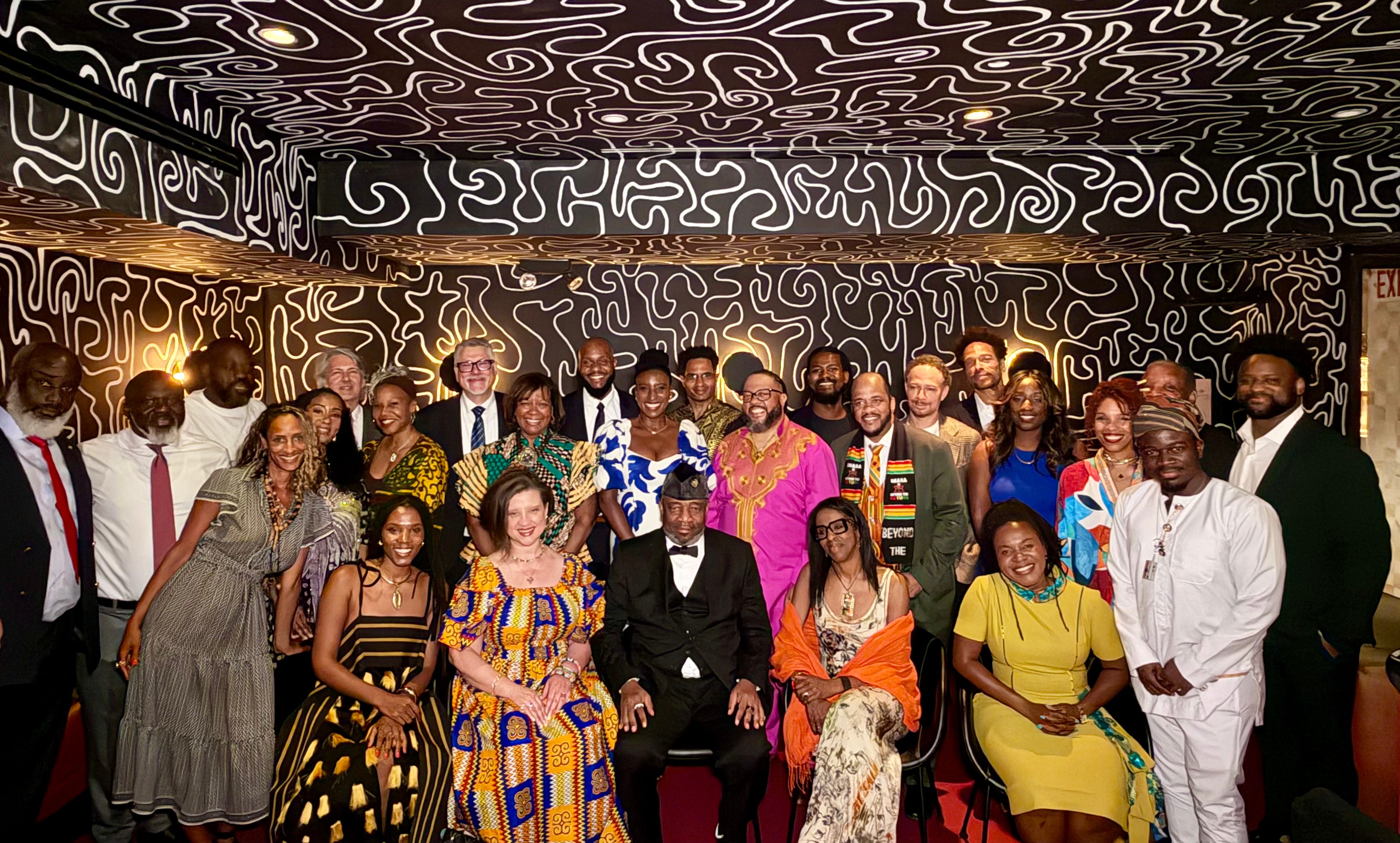
Last week I sat at a table in New York City that felt less like a dinner and more like a threshold.
The occasion was intimate by design, an evening with the Ga Mantse, the King of Accra, which I had the honor of hosting in partnership with the Office of the Ga Mantse and the Africa Investment Network. And there is something I don’t want to move past too quickly: the King came to us. He left Accra and crossed an ocean to sit with the diaspora in New York. In a moment when so much conversation about the continent still expects the diaspora to make the journey inward, the direction of travel here mattered. It was an act of welcome, a homecoming offered on this side of the water, and a signal of the significance he placed on meeting us where we are, so that we could build together. Not in the abstract, and not someday. Now.
The King set the tone. He spoke of urgency, of this particular moment as a call rather than a coincidence, and of the revitalization and resurgence of Pan-Africanism as work that belongs to our generation. Then he offered an image worth sitting with. The evening, he said, was a blank canvas. None of the paint had yet touched it. And every person in the room would play a part in creating the picture, the future, that we hope to see. It reframed the whole night. We weren’t there simply to be hosted. We were there to shape what the evening became and to take ownership of what it might lead to.
What struck me most was who was in the room. Entrepreneurs. Creatives. Corporate professionals. People who, in another setting, might never share a table, brought together in both the spirit and the practice of Pan-Africanism. That distinction matters to me. Spirit is the feeling: the pride, the belonging, the emotional pull toward home. Practice is the harder thing: the deals, the partnerships, the cultural preservation, the actual building. What made the evening rare is that it held both. People talked, connected, and left with the beginnings of something concrete, investment opportunities on one hand and cultural preservation work on the other.
I’ve been thinking a lot lately about ecosystems, about how they’re really made and by whom. This dinner was a glimpse of exactly the kind of ecosystem building I want to see more of, and a preview of what we’re carrying into the Black Capitalists gathering at Martha’s Vineyard this August. The through-line is the same: create the conditions for the right people to meet, then get out of the way and let them build.
And the timing is not lost on me. We are living through unprecedented political times, and it would be easy to read this era only through the lens of what feels precarious. But I keep returning to the other story unfolding at the same time, the rise of Africa. The continent is young, ambitious, and increasingly the place where the future is being drafted. Ghana, in particular, continues to position itself as the entry point, the door through which the diaspora walks home and the continent extends its hand outward. And last week that door swung both ways. The King did not wait in the doorway for us to arrive; he stepped through it, all the way to New York, to help build the common ground himself. That is what it looks like when the diaspora and the continent decide to meet as equals and build with one another rather than merely for one another.
A composition is beginning to take shape on the canvas. And after last week, I have a clearer sense of the picture we are painting, and of who is in the room to paint it.
A final note. If this is a room you want to be part of, the next one is already forming. This August, the conversation continues at Martha’s Vineyard, where the Black Capitalists convening will bring more of us to the same table to connect, invest, and build together. Consider this your invitation to step into the room and help shape what comes next.
With hope,
Dr. Rachel