

Estimated read: 9 minutes
There is a kind of news cycle that arrives with predictable cadence in American life. A tariff is announced. Markets jolt. Small businesses send anxious notes to their accountants. Wholesale prices climb. Retailers absorb what they can and pass on what they cannot. Within two quarters, the labor market begins to soften. And within three quarters, somewhere in a research note from a Washington think tank, a sentence appears that says, in slightly different words each time: Black unemployment has risen disproportionately.
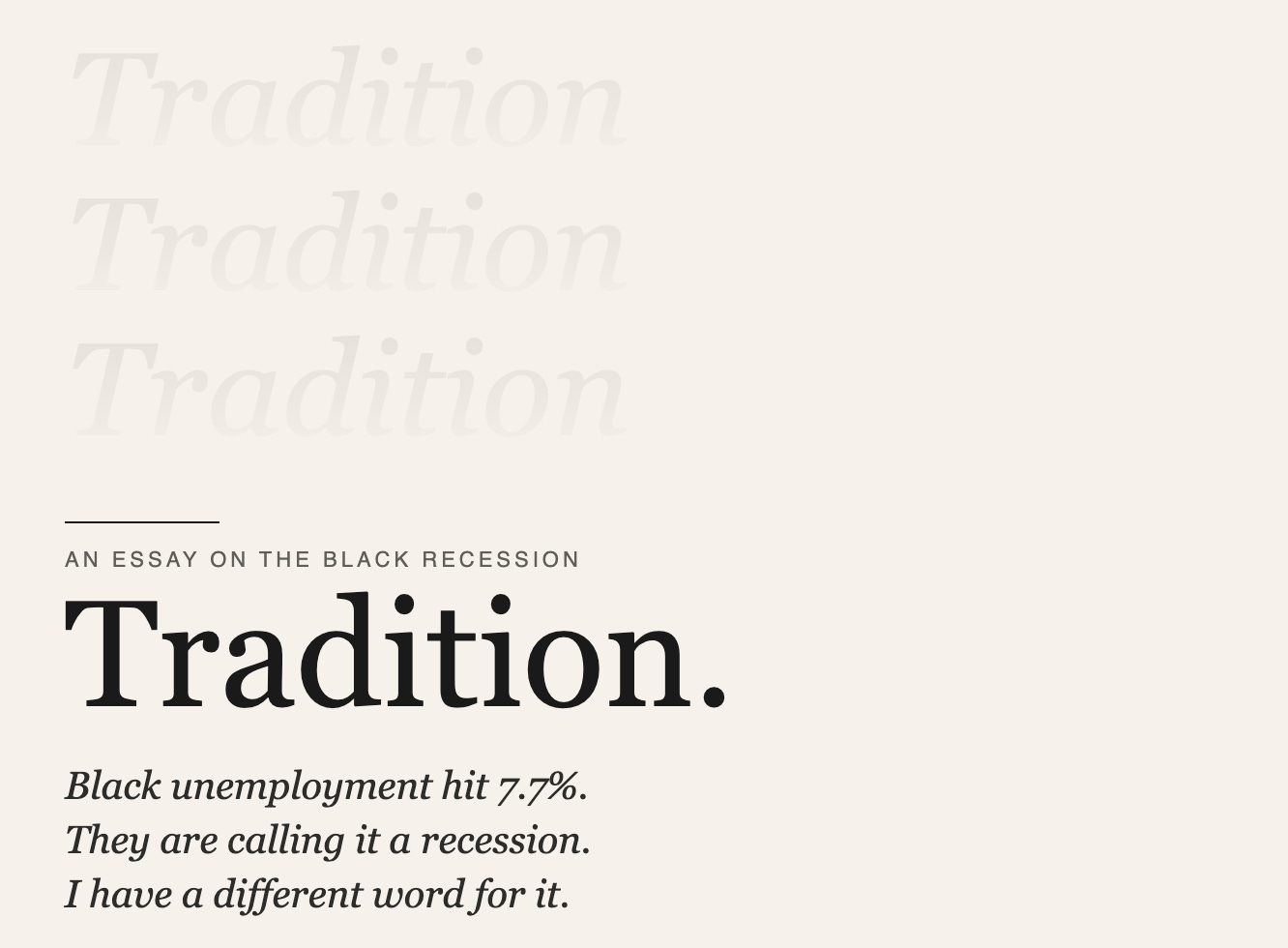
Earlier this year, that sentence appeared again. In February’s BLS report, Black unemployment hit 7.7 percent — the highest in four years. The March print eased to 7.1 percent. April’s came in at 7.3 percent. None of those numbers tell a story of recovery so much as a story of a stubbornly elevated baseline for Black labor while the headline national unemployment rate looks comparatively unbothered. The Joint Center for Political and Economic Studies is calling it a Black recession. Media outlets are picking it up. People are asking what to do.
I want to offer a different vocabulary. What we are watching is not a recession. It is a tradition.
The pattern, the pattern, the pattern
Every time the U.S. economy is disrupted — 1929, 1973, 1981, 2001, 2008, 2020, and now 2026 — the same script runs. Tariffs go up or credit tightens or oil shocks or a virus arrives or a war breaks out. Input costs rise. Margins compress. Small businesses contract first. The retail and transportation sectors, where Black workers are overrepresented, shed jobs first. Black unemployment rises faster than the national average and falls more slowly. By the time the country is officially in recovery, Black households are further behind than they started.
This is not a glitch. This is not a coincidence. The economist William Darity Jr. has been describing this for forty years as the racial structuring of risk. The country has built an economy in which Black labor sits closer to the shock-absorbing edge by design — in the sectors most exposed to import-export volatility, automation, and discretionary consumer spending — and the result is a labor market in which Black Americans take the worst of every downturn and a smaller share of every recovery.
The current tariff regime, which the Tax Foundation calls the largest U.S. tax increase as a share of GDP since 1993, is operating exactly to type. Retail and transportation are shedding jobs. Small businesses with fewer than twenty employees — the size category that contains the overwhelming majority of Black-owned firms — have shed sixty-two thousand jobs since January 2025. Household goods are more expensive. Wages are not keeping pace. And the cohort of professionals laid off in the DEI rollback is now competing for senior roles in a contracting labor market.
If your only frame for this is recession, you will spend the next eighteen months on defense. You will read forecasts. You will worry about your industry. You will perhaps trim your budget. And when the cycle turns, you will sigh in relief and go back to whatever you were doing before. And then four or six or eight years from now, the cycle will turn again, and we will all sit here writing the same articles, again, with new dates on them.
If your frame is tradition, you do something different. You stop asking when this one will be over. You start asking what infrastructure outlasts the cycle.
What my fieldwork taught me to look for
For my dissertation, I divided my time between two sites: Wall Street and Accra. I followed Black professionals who had worked in finance in New York or London and then made the deliberate decision to spend part or all of their time building in West Africa. Some of them I met during Ghana’s 2019 Year of Return campaign, when the President invited the global Black diaspora home. Others I met because they were already there, doing things that did not yet have a name.
What I learned, watching them, is that the most resilient Black Capitalists in my data were not just diversified across asset classes. They were diversified across geographies, currencies, political systems, and identities. They had one foot in Brooklyn and one in Accra. They held a U.S. passport and a Ghanaian passport. They had a job at a U.S. firm and a stake in a Lagos startup. They had a Roth IRA and they had cocoa land outside Kumasi. They were, in their own quiet way, hedging the United States.
This is not anti-American. It is anthropologically honest. When you have lived enough decades in a country that experiences its labor shocks racially, you stop treating that country as the only thinkable home for your capital. You start to consider that the strategy might require more than one address.
Dual citizenship as a wealth strategy
I use the phrase dual citizenship deliberately, and not only in the passport sense. I mean it as a posture. The most strategic Black Capitalists I know carry dual citizenship of identity — Black American and global African — and they let that double belonging shape where their capital sits. They invest in Black-owned funds in the U.S. and emerging-market funds in West Africa. They support Black founders in Atlanta and Lagos and Nairobi. They route a portion of every paycheck into something that is not denominated in U.S. dollars and is not subject to the next U.S. trade policy decision.
This is not paranoia. This is, frankly, what the U.S. wealthy have done for centuries with offshore accounts and second homes and dual citizenships of convenience. The only difference is that the diaspora is doing it with intention and orientation — toward a continent, not away from a country.
If you are inside the cycle right now
If you are reading this because you have been laid off, or because you are worried about your role, or because the headlines are giving you a low hum of dread that sits behind every meeting, I want to say two things.
First, you are not imagining the pattern. The pattern is real. The pattern has a name. The pattern has a literature. You are not weak for being affected by it. You are paying attention.
Second, the response is not to white-knuckle the next eighteen months and hope. The response is to build, in whatever increment you can — twenty dollars a month, two hundred, two thousand — toward the kind of dual-citizenship wealth posture that outlasts any given administration. The Black Capitalists in my data did not start with millions. They started with the same paychecks the rest of us have. They simply made a different set of decisions about where each paycheck went and what it was building toward.
This August, I am pulling together a small group of people on Martha’s Vineyard who are operating from this posture — strategists, founders, allocators, scholars, artists, leaders from across the diaspora and the African continent. If your work or thinking sits in this space, send me a note.
More soon,
Dr. Rachel
Great article Dr Rachel. I’ve been living and working on this space for 6 years now. Thanks for your insight!
Keep it coming, Dr. Rachel. You continue to provide thoughtful, insightful and actionable content for our times. Thank you .