

Photo Credit: Alyson Hurt/NPR
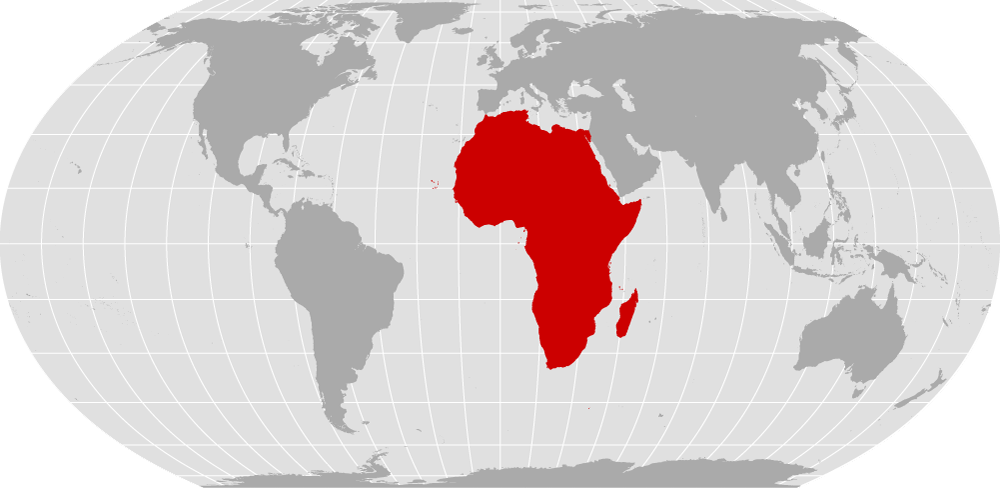
On Friday, the United Nations General Assembly voted to fix the map. 164 countries in favor, one against, six abstentions. The one against was the United States. Togo carried the resolution on behalf of the African group, and what it asks for is fairly modest. It encourages governments, schools, international organizations, and technology companies to use the Equal Earth projection and other equal-area maps when relative size matters, and to teach people why no flat drawing can tell the whole truth about a round planet. It is nonbinding. It bans nothing. The text calls the correction an act of “cognitive justice and memorial reparation.” Togo’s foreign minister, Robert Dussey, said it more plainly on the day of the vote. “A fair map does not change the geography of the world,” he said. It changes how we see it.
I am an anthropologist by training. Anthropology is the study of the gap between the story people tell about their lives and the way those lives are actually organized. The story and the system are almost never the same thing, and the distance between them is where real information sits. A map is the simplest example I know. It presents itself as a neutral picture of the world. It is also a quiet set of instructions about what matters.
Gerardus Mercator drew his projection in 1569 to solve a sailor’s problem. On his map, a straight line matches a constant compass direction, which is useful if you are crossing an ocean and would like to survive it. The trade he made was area. Everything drifts larger the farther it sits from the equator, so Greenland ends up looking about the size of Africa, when Africa is roughly 14 times larger. The reality of this did not stay on the page. It moved onto classroom walls, into software defaults, and into every news graphic that has ever tucked the continent into the bottom right corner like a footnote. The resolution says it directly: these distortions have contributed to the symbolic minimization of Africa. Selma Malika Haddadi, deputy chairperson of the African Union Commission, has argued that this was never really about cartography, and that the stereotypes it feeds run straight through media, education, and policy. Moky Makura, executive director of Africa No Filter, which built the Correct The Map campaign with Speak Up Africa, has called the Mercator standard “the world’s longest misinformation and disinformation campaign.”
They are right, and here is the even harder thing worth saying: being seen accurately is not the same as being valued correctly. That gap is precisely the one I was trained to study, and it is where the future gets decided.
The correction is real, and we won it
The map did not change because the world woke up one morning feeling generous. It changed because advocacy organizations on the continent built a campaign, the African Union endorsed it, African states carried it into a multilateral body, and they won the vote by an enormous margin. That sequence matters more than the projection does. It is a working demonstration of Africans setting the agenda inside an institution that was not built with African agendas in mind.
Notice who objected, and how. The American representative said the resolution belonged to a much larger and more radical ideological project, singled out its references to reparations and cognitive justice, and called initiatives like it “barnacles on our work here.” Six countries abstained, most of them over an unrelated worry about how equal-area maps draw disputed borders. It is worth asking why a change to a projection would register as a threat at all.
Scale is not a neutral fact. Scale is a claim about consequence. To draw a place accurately is to admit that what happens there matters, and that admission is expensive for anyone whose position depends on the opposite.
Equal-area maps do not make Africa bigger. Nothing about the continent grows. What shrinks is the exaggeration Mercator hands to everything near the poles. France grasped this immediately and went the other way from Washington, announcing hours before the vote that it would drop Mercator for its own maps, knowing the country would itself appear smaller as a result.
What you can actually see now
The World Bank projects that sub-Saharan Africa will add 625 million people to its working-age population between now and 2050, which is more than three quarters of the entire increase in the world’s working-age population over that stretch. East Asia and the Pacific will lose more than 200 million working-age people in the same window. By 2035, more than 330 million people between the ages of 15 and 24 will live in the region, close to two and a half times the number there in 2000. Africa’s median age in 2050 is projected at around 25. Europe’s will be around 46.
The numbers are not a forecast about strangers who might one day exist. Nearly all of the people who will be working in 2050 have already been born. They are in somebody’s classroom right now. Whoever is going to build, staff, invent, and buy in the second half of this century is disproportionately going to be African, which is why I am writing a book called The Future of Work is African. By the World Bank’s own regional accounting, as many as 12 million young people enter the labor market in the region every year while only about 3 million new formal wage jobs are created annually. That is roughly one formal job for every four young people who show up looking. A young population produces a dividend only when there is an economy built to pay it. Otherwise it produces pressure, and everyone here knows what pressure looks like.
Seen is not the same as owned
A distorted map kept Africa small in the global imagination for four and a half centuries. It is fair to ask whether the same forces that profited from smallness will now find it more profitable to acknowledge bigness. I think the answer is yes. I also do not think that makes last Friday a trap. It makes it a threshold.
Attention is what brings capital, and capital shows up with terms attached. We have a live case study in how that goes, and it is worth walking through slowly, because the details are where the argument is.
Cobalt goes into batteries, which go into phones and cars and the grid. The Democratic Republic of Congo mines roughly three quarters of the world’s supply and holds about half of known reserves. What it does not have is a single working plant that turns that cobalt into battery material. The refinery it has announced is not expected to run before 2030. Refining is the unglamorous middle step and it is where the money is. The International Energy Agency reports that refining concentration hit a record in 2025, with the average share held by the top refined supplier rising to 70 percent from 68 percent in 2020, and that for graphite, gallium, manganese, and rare earths, China alone accounts for more than 90 percent of global refined supply. The same pattern is being set up in graphite right now. Madagascar, Mozambique, and Tanzania could together supply about a third of the world’s mined natural graphite by 2040, up from roughly 11 percent in 2025, and on current capacity almost none of it would be processed into battery-grade material anywhere near them.
So here is the shape of the danger, in anthropological terms: the story the world is telling this week is that Africa has finally been seen. The system underneath is organized so that what gets seen is inventory. You can be drawn perfectly to scale and still be a line item in somebody else’s supply chain.
However, we are already deciding
The counter-example is already running.
In February 2025, the DRC stopped cobalt exports altogether. That autumn it swapped the ban for a quota, capping exports at 96,600 tonnes for 2026 and again for 2027, roughly half of what the country produced in 2024. Cobalt entered 2026 at about $56,400 a tonne, up from roughly $21,000 in early 2025. The IEA now treats the number Kinshasa sets as a central variable in whether the world runs a cobalt surplus or a shortage. About a tenth of the annual ceiling is held back for a state reserve, and in the middle of this year the regulator told producers that any allocation they had not shipped would be forfeited into it.
Zimbabwe did a version of the same thing with lithium, refusing to let unprocessed ore leave and then tying export quotas to commitments to process at home. Its mines ministry attributes more than $3 billion in processing-plant investment to that policy, and the country opened its first lithium refinery in the first half of this year.
You can argue with how any one of those decisions was executed, and there is real risk in all of them. What I’m highlighting here is the category. This is what it looks like when a country stops accepting the price it is handed and starts naming one. That is happening now, while the ink on the resolution is still wet.
Who gets to decide
African governments hold the policy instruments, and the last two years have shown they know it. Coordination is the open question. One country restricting exports creates a price shock. Several countries moving together create a floor.
Global capital is coming regardless of how anyone feels about it, drawn by the minerals, the consumer market, and the labor supply. The question was never whether it arrives. It is what it owns when it does, and who is sitting on the board when the decisions get made.
African firms and entrepreneurs are the layer that determines whether the growth stays or leaves. Processing, logistics, energy, software, and all the infrastructure between the raw thing and the finished thing are where the margin lives.
And then there are those of us in the diaspora. We are often the interpreters in these deals. We get hired precisely because we can move between a boardroom in New York and a ministry in Accra, and that position cuts two ways. We can be the friendly face that makes an extractive term sheet go down easier, or we can be the people who insist the term sheet include local equity, local governance, technology transfer, and a commitment to process on the continent. Capital behaves differently depending on whose hands it passes through, and our hands are increasingly on the deal.
—
The story changed last Friday. The system did not. My whole discipline exists because those two things move at different speeds, and the honest work is in the space between them. What is different now is that the argument I have been making, that Africa sits at the center of the global economic future rather than at its edge, no longer asks anyone to imagine anything. They can see it. That is a real gift and a short window.
The future here is genuinely undecided.
More soon,
Dr. Rachel
Sources
“UN tells the world: Stop making Africa look small,” UN News, 4 September 2026. Primary source for the vote count of 164 to 1 with six abstentions, the identity of the abstaining states, the nonbinding scope of the resolution, the “cognitive justice and memorial reparation” language, the Dussey quotation, the US statement, France’s announcement, and the point that equal-area maps remove polar exaggeration rather than enlarge Africa. https://news.un.org/en/story/2026/09/1168284
“UN votes to adopt new world map that reflects countries’ true relative sizes,” CNN, 4 September 2026. https://www.cnn.com/2026/09/04/world/un-vote-new-world-map-intl-scli
“The U.N. backs a new world map showing Africa in its true relative size,” NPR, 4 September 2026. https://www.npr.org/2026/09/04/nx-s1-5958611/africa-world-map-un-vote
“UN votes to adopt new world map that reflects Africa’s true size,” Al Jazeera, 4 September 2026. https://www.aljazeera.com/news/2026/9/4/un-votes-to-adopt-new-world-map-that-reflects-africas-true-size
“African Union urges adoption of world map showing continent’s true size,” Reuters. Source for the Haddadi and Makura remarks and for the African Union’s endorsement of the campaign. https://www.yahoo.com/news/articles/african-union-urges-adoption-world-101441939.html
Correct The Map campaign, Africa No Filter and Speak Up Africa. https://correctthemap.org/
“Africa will supply 75% of new global workers by 2050, World Bank projects,” Nairametrics, 6 September 2026, reporting the World Bank Data Blog projection. Source for the 625 million figure, the three-quarters share of global working-age growth, the East Asia and Pacific decline, and the 330 million people aged 15 to 24 expected in the region by 2035. https://nairametrics.com/2026/09/06/africa-will-supply-75-of-new-global-workers-by-2050-world-bank-projects/
World Bank, Africa Regional Overview. Source for the twelve million young people entering the labor market annually against roughly three million new formal wage jobs. https://www.worldbank.org/en/region/afr/overview
“Demographic Dividend,” ISS African Futures. Source for projected median ages of about 25 in Africa and 46 in Europe in 2050. https://futures.issafrica.org/thematic/03-demographic-dividend/
International Energy Agency, Global Critical Minerals Outlook 2026, Market Overview. Source for record refining concentration and the top refined supplier average share of 70 percent in 2025. https://www.iea.org/reports/global-critical-minerals-outlook-2026/market-overview
International Energy Agency, Global Critical Minerals Outlook 2026, Outlook. Source for China accounting for more than 90 percent of refined supply of graphite, gallium, manganese, and rare earths. https://www.iea.org/reports/global-critical-minerals-outlook-2026/outlook
“IEA Global Critical Minerals Outlook 2026: Africa Analysis,” Energy Transition Africa, July 2026. Source for the graphite projection covering Madagascar, Mozambique and Tanzania, and for Zimbabwe’s first lithium refining facility. https://www.energytransitionafrica.com/insights/article/iea-global-critical-minerals-outlook-2026-africa-analysis
“Regional Note on Critical Minerals in Africa,” OECD, April 2026. Source for the DRC’s share of global mined cobalt and reserves and for the absence of significant African refining capacity. https://www.oecd.org/content/dam/oecd/en/events/2026/04/critical-minerals-forum/oecd-critical-minerals-regional-note-africa.pdf
“Dried-up feedstock pipeline sends cobalt prices soaring in 2025, deficit seen next year,” Fastmarkets. Source for the DRC having no operational cobalt refining capacity and for the announced sulphate refinery targeted at 2030. https://www.fastmarkets.com/insights/dried-up-feedstock-pipeline-cobalt-prices-soaring-2025-deficit/
“Cobalt Export Quotas and Copper Supply Risks Shape DRC Revenue Outlook,” Ecofin Agency, January 2026. Source for the February 2025 export suspension, the 96,600 tonne quota for 2026 and 2027, and the price level entering 2026 against the early 2025 baseline. https://www.ecofinagency.com/news-industry/2101-52126-cobalt-export-quotas-and-copper-supply-risks-shape-drc-revenue-outlook
“DRC to Reclaim Unused Export Quotas from Cobalt Miners,” Investing News Network, 30 June 2026. Source for the strategic reserve and the forfeiture of unshipped allocations, reported from ARECOMS. https://investingnews.com/drc-reclaims-unused-cobalt-quotas/
“Mineral Processing: Africa’s Gateway To Global Competitiveness,” African Leadership Magazine. Source for the Zimbabwe mines ministry figure of more than three billion dollars in processing-plant investment. https://www.africanleadershipmagazine.co.uk/mineral-processing-africas-gateway-to-global-competitiveness/