

I want to start somewhere other than where this conversation usually starts.
The usual version goes like this: AI is coming for Black people’s jobs. Amazon has cut roughly 30,000 corporate roles since October 2025. AI has been the single most cited reason for layoffs in the country for two straight months in the Challenger, Gray & Christmas report. Black workers are overrepresented in exactly the functions getting automated first, the clerical, customer service, and administrative roles where nearly one in five workers is Black. All of that is true. I could write that essay in my sleep, and so could you, because we have already read it a hundred times.
So let me write the one I have not seen.
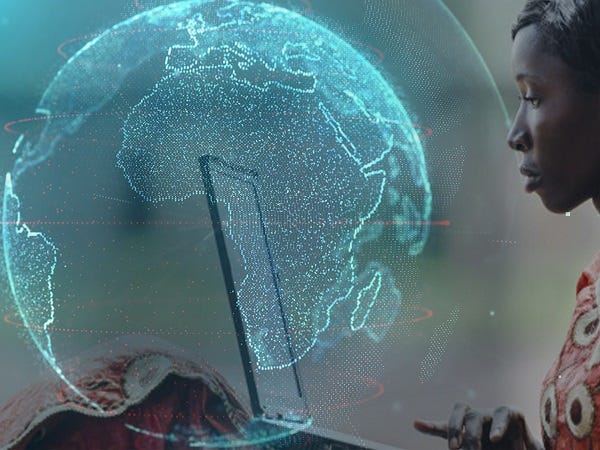
The intelligence that is being pointed at Black American jobs did not assemble itself. Somebody had to teach it the difference between a threat and a joke, between a face and a shadow, between toxic content and ordinary speech. Somebody had to sit with the rawest, most violent material on the internet and label it, hour after hour, so the model could learn to recognize the world. A great deal of that somebody is in Nairobi. In Lagos. In Accra, Kampala, Kigali.
Here is the sentence I want to sit with you. The judgment inside these systems, the faculty that now makes a Black worker in Atlanta redundant, was substantially manufactured by Black workers in Africa, for somewhere between one and two dollars an hour. The displacement is Black at one end of the value chain, and the labor is Black at the other end of it, and the ownership is in neither place. That is the story. Everything else is detail.
The machine has Black hands
When OpenAI needed to make ChatGPT safe enough to release, it relied on a San Francisco firm called Sama, which employed workers in Kenya to read and classify the worst text the internet produces: detailed accounts of child sexual abuse, torture, suicide, self-harm. Those workers were paid a take-home wage of roughly $1.32 to $2 an hour. OpenAI paid Sama around $12.50 an hour for the same labor. Many of the Kenyans who did it came away with PTSD, depression, and worse. They were detoxifying the product so the rest of us would never have to see what they saw, and the product they made safe is now cited as the leading reason American workers are losing their jobs.
This is not one bad contract. It is the architecture. Nigeria has become an annotation hub, with Ghana, Rwanda, Uganda, and South Africa close behind. Scale AI ran much of this work through a platform called Remotasks, which leaned heavily on Kenyan and Nigerian labelers and then abruptly shut down its operations in both countries in 2024, stranding thousands of people who had built their incomes around it overnight. The going rate across the continent hovers around $2 an hour for work that pays roughly $20 an hour to an American doing the identical task. Researchers have a name for this layer of the economy. They call it dark labor, or ghost work, precisely because it is engineered to be invisible. You are not supposed to know whose hands are inside the machine.
When I sit with this as an anthropologist, I do not see a new economy. I see the oldest one we have, wearing a new interface. Raw material is extracted cheaply from African bodies and African ground. It is refined into a high-margin product somewhere else. And it is sold back into a market where Black labor, this time on the other side of the Atlantic, is rendered surplus. The cotton is now cognition. The plantation is now a content queue. But the structure, raw Black input at the bottom, concentrated white ownership at the top, and Black expendability at both ends, is familiar to all of us.
Two displacements, one value chain
We keep treating the African annotator and the laid-off American rep as two unrelated news stories. They are the same story. They are two points on a single value chain, separated by an ocean and a wage, and joined by the same fact: neither of them owns any part of what they built or what replaced them.
The worker in Nairobi sells her judgment by the hour and keeps none of the asset her judgment created. The model trained on her labor appreciates into a company worth billions. The worker in Atlanta is then displaced by that very model and keeps nothing either, except a severance package and an earnings cliff. Decades of displacement research show that workers pushed out of stable jobs lose 20 to 30 percent of their earnings for years, not months, and the more recent work shows those losses fall hardest on Black workers, who have the least cushion to absorb them. Put that next to the wealth gap, a median Black household holding about $44,900 against a median white household’s $285,000, and you can see the whole circuit. Black labor builds the intelligence. Black labor gets displaced by the intelligence. White capital owns the intelligence and pockets the spread.
The mistake, on both ends of that ocean, is the same mistake. It is treating a paycheck as a position. A wage is not a stake. It is a thing that can be ended in a quarterly memo, whether the memo is written about a content-moderation contract in Kenya or a customer-service team in Texas.
The fork in Africa, and why it matters to us
Here is where the story stops being a lament and starts being an argument, because Africa is not only the backend of somebody else’s machine. It is also, right now, the most interesting site of an ownership counter-move anywhere in the Black world.
Strive Masiyiwa’s Cassava Technologies has begun building Africa’s first AI factories, deploying sovereign computing infrastructure in South Africa with plans to scale into Nigeria, Kenya, Egypt, and Morocco, and pledging up to $720 million toward it. Nvidia took an equity stake in the company. That detail matters more than it looks: for once, the equity is flowing toward Africa rather than only the labor flowing out of it. Lelapa AI, founded by Pelonomi Moiloa and Jade Abbott in Johannesburg, has built InkubaLM, a model designed from the ground up for African languages that the big Western models treat as afterthoughts. Masakhane, a grassroots network of African researchers, has been doing this work since 2019 and just drew a multimillion-dollar grant to keep going. And Nigeria, Kenya, and Egypt have all published national AI strategies since early 2025 that say the quiet part plainly: dependence on Google, Microsoft, Nvidia, and Meta is a threat to their sovereignty.
So the continent stands at a fork. One road keeps Africa as the world’s cheapest cognitive supplier, providing the labor that makes everyone else’s models smart while owning none of them. The other road is sovereignty: African data, on African infrastructure, training African-owned models, with the value staying home. The difference between those two roads is not technology. Both roads run on the same chips. The difference is ownership. It is the exact same difference that separates the Black worker who has only a paycheck from the Black worker who has a stake.
That is why this is not a foreign story. The fork in Lagos and the fork in Atlanta are the same fork. A people whose relationship to the global economy has been organized as labor rather than ownership are being asked, on both sides of the ocean and at the same moment, whether they will own the most important asset of the century or merely staff it.
The Black Capitalist read
The Black Capitalists I write about, and the ones I am gathering on the Vineyard this summer, are already reading the map this way. They are not asking whether AI will take their jobs. They are asking who owns the intelligence, and how to get on the right side of that question while there is still room on the cap table.
In practice that looks like taking equity instead of only earning wages. It looks like writing LP checks into Black-led and Africa-led funds rather than only depositing into a 401(k). It looks like buying small businesses across the diaspora that have not yet touched AI and using these tools to make them more productive and more valuable. And increasingly it looks like understanding the diaspora as a single capital map, where a stake in a Nairobi data company and a stake in an Atlanta-based AI startup are not exotic and domestic, but two moves in one coherent strategy. The annotator’s labor and the founder’s equity are points on the same chain. The Black Capitalist move is to stop selling labor into that chain and start owning pieces of it.
I keep returning to one uncomfortable truth, because I think it reframes everything. The question is usually posed as whether Black people are inside or outside the AI revolution, as victims standing in its path. But Black people are already inside the machine. We built its judgment. African hands taught it to see. That is not a tragedy to mourn. It is leverage to recognize. You do not beg your way into an asset you already manufactured. You take ownership of it.
Where to start, if you are starting
The move from labor to ownership is never one decision. It is a slow accumulation of them. A first equity position. A first check into a Black-led or Africa-led fund. A first stake in a friend’s company. A first small business you own outright. A first conversation with a wealth manager about something other than your salary. Nobody in my data arrived at ownership in a single leap. They got there over years of deliberate accumulation, very often while still clocking in at the same kind of firm that was automating other versions of their own role. That is not a contradiction. That is the strategy.
This August I am hosting a small gathering on Martha’s Vineyard, Black Capitalists: The Vineyard Convening, to bring together people doing exactly this work across the continent and the diaspora. If you are building inside the question of who owns the intelligence, on either side of the Atlantic, I would love to hear from you. The room is invitation-only and intentionally small. Send me a note.
More soon,
Dr. Rachel
Great insights here that I would have never considered as someone in the West. Thanks for sharing!