

Seven years ago, Jay-Z shook hands with Roger Goodell and the verdict was instant: sellout. The think pieces wrote themselves. He had stepped over Colin Kaepernick. He had laundered the NFL’s guilt for a seat at the owners’ table. The Black community, that elastic, moralizing “we” that is so good at issuing verdicts and so bad at writing strategy, buried him.
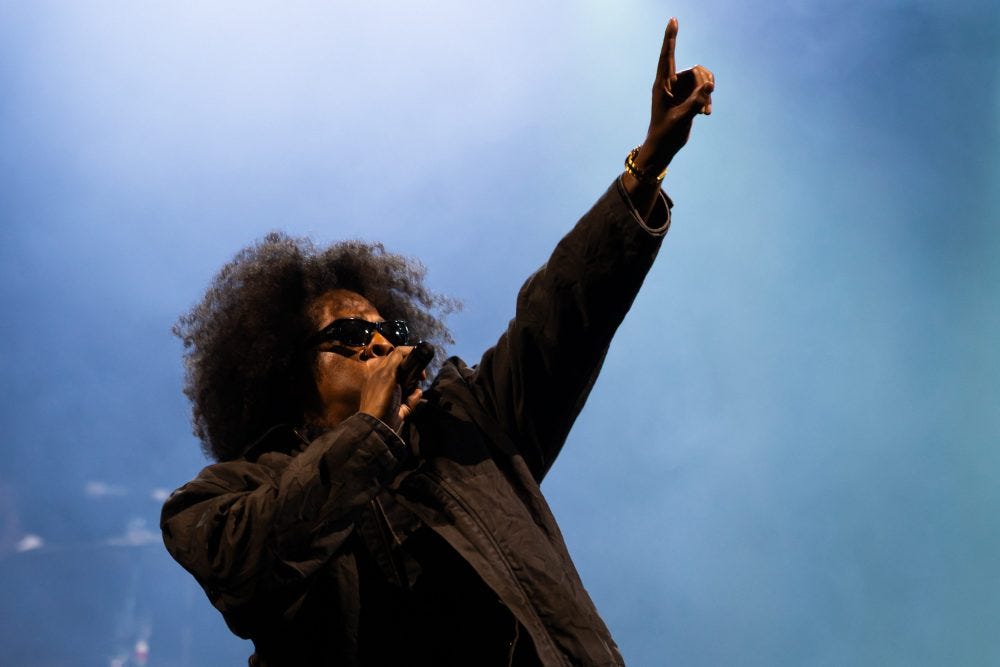
Last weekend, Jay-Z walked onto the Roots Picnic stage in Philadelphia with his locs picked out into an afro and delivered a four-minute freestyle the same community will be quoting for a month. The verdict was instant again, only inverted: icon, king, the GOAT, he’s back. The hair did half the work. We baptized him in our love the way we once condemned him with our contempt, and we will not, as a culture, sit still long enough to notice that we did both.
This is the part of the cycle I want to name plainly, because I am tired of watching it move in circles without yielding anything. We are not actually responding to Jay-Z. We are responding to ourselves. We use public figures, especially Black ones with money, as mirrors for our unresolved questions about complicity, assimilation, and what success is allowed to look like. When we hate, we hate hard. When we love, we love loud. The middle, where strategy lives, is the territory we keep refusing to enter.
I wrote a chapter on the NFL deal in Black Capitalists. My argument then is my argument now: the sellout reflex is cheap. It costs us nothing to deploy and it teaches us nothing. The harder, more useful question is the one almost no one asked when the deal was signed and almost no one is asking when the afro is celebrated. What is the play? What has Roc Nation’s NFL position actually moved, in dollars, in ownership, in the social-justice infrastructure the deal was sold on? Has the needle moved, or have we just changed the soundtrack we cheer along to? I am not interested in vindicating Jay-Z. I am interested in the audit.
The audit is the thing we keep skipping. Without it, the love cycle and the hate cycle are the same cycle. Both are reactions. Neither builds anything.
Now place this pattern next to the DEI conversation. Five years ago, every Fortune 500 was racing to issue a Black Lives Matter statement, hire a Chief Diversity Officer, and post a black square. The applause was thunderous. We celebrated the corporate awakening like it was a movement. This year, more than half of S&P 100 companies have quietly scrubbed DEI from their major filings; the acronym is down 68 percent across the S&P 500; Amazon, Meta, Target, Google, and McDonald’s have walked back programs they once trumpeted. The outrage is thunderous. We are organizing boycotts, posting receipts, demanding accountability.
Look at the shape of it. Praise, contempt, praise, contempt. The corporations didn’t change. Their incentives did. They responded to social and political pressure in 2020 and to social and political pressure in 2025, and in both cases the underlying calculus was the same: reputational risk management. I know what that phrase means because I used to write the memos. At Goldman, “the right thing to do” was never a sufficient business case. “Reputational risk management” was. That is what was paying for the programs we celebrated, and that is what is paying for the rollbacks we now mourn. Same engine. Different direction.
If our analysis stops at “they betrayed us,” we have learned nothing we did not already know. Corporations are not your community. They were not your community when the statements went out and they are not your community now that the statements have been deleted. The question that materially changes lives is not whether to be angry, because anger is free. The question is whether to be strategic. Where did the actual capital flow during the boom? Which programs survived the rollback, and why? Which Black founders, employees, and institutions used that window to build something durable, and which ones built dependencies on commitments that were always conditional? Who owns what now that didn’t own it before?
This is anthropology, not cynicism. I am describing what I see human beings, in groups, repeatedly do. We bond through shared feeling, and outrage is the most efficient bonding agent we have invented. It does not require us to read a balance sheet, study a contract, or follow a deal for five years to see what it produced. It only requires us to feel together, loudly, for about seventy-two hours, before the next thing arrives to feel about. The cycle is psychologically satisfying and materially inert.
So here is what I am asking, of myself and of anyone who is tired of running the same loop:
Stop grading the performance. Start reading the strategy. When a Black billionaire signs a deal with an institution that has wronged us, the relevant question is not “is he one of us?” It is “what does this deal make possible, what does it cost, and who is keeping score?” When a corporation announces a DEI commitment, the relevant question is not “do we trust them?” It is “what is the mechanism, what is the timeline, and what are we building on top of it so that when they retreat, and they will retreat, we are not left holding nothing?” When the same corporation reverses course, the relevant question is not “how dare they?” It is “what did we extract while the window was open, and what does the rollback teach us about where to put the next dollar, the next hire, the next institution we build?”
The afro is beautiful. The freestyle was sharp. The hat tip to Philadelphia was earned. But none of that is the point. The point is that in seven years a man went from sellout to saint in the same community’s mouth without any of us being able to articulate what changed, and in five years a country of corporations went from allies to enemies without any of us being able to articulate what we won. Two cycles. Same mechanism. Same cost.
Cut through the noise. The truth being revealed in these moments is not about Jay-Z and it is not about Amazon. It is about us. About how easily we are moved, how rarely we are organized, and how often we mistake reaction for power. The work is to stop performing the cycle and start being the audit. That is the only place strategy lives.
I’m putting together a strategic convening of leaders on Martha’s Vineyard this August. If you would like to learn more, reach out.
More soon,
Dr. Rachel
This is an important and nuanced discussion you have put forth. I hope it breaks through. ❤️
I always have a mix of feelings when I read about Black celebrities. My first feeling is that I'm not like Jay-Z because I'm not a billionaire. When he signs with Roger Goodell or performs, no matter his color, he's not like me.
My assumption is the he is looking to make more money for himself.
Is that selling out? Or his he just playing the capitalist game to his benefit.
Did I sell out by working for various companies that supported trump? I think it is a very nuanced conversation and it's different based on who you are.